Resources:
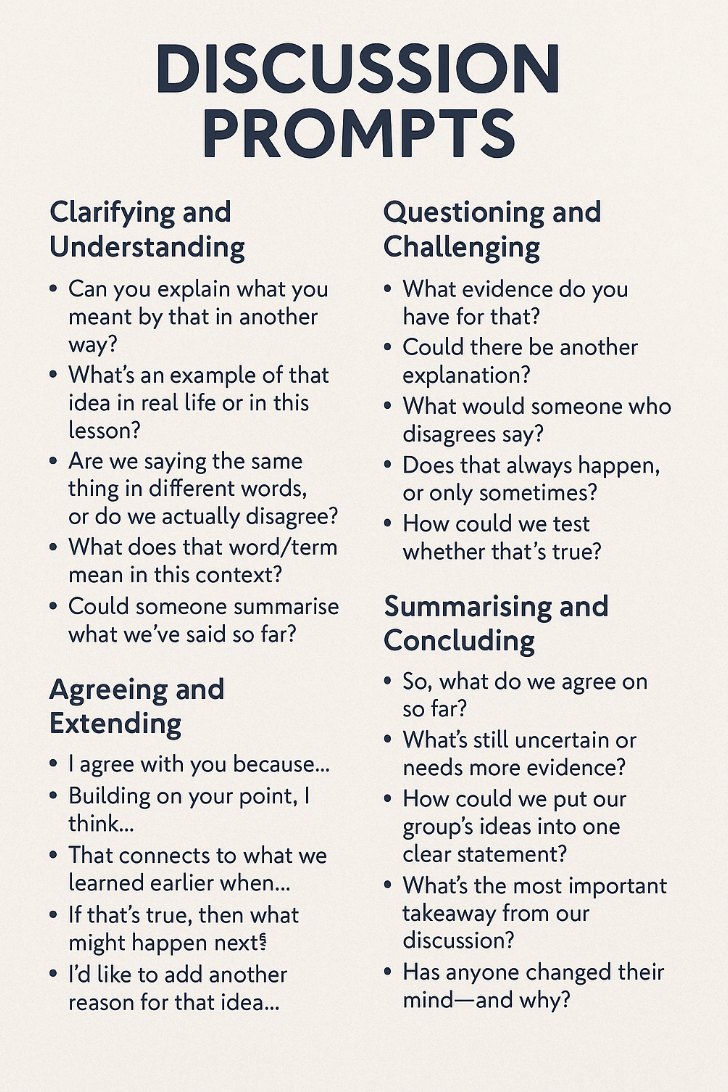
Right Click and save my ready to use discussion prompts to print/hand out or show on the board to help students discuss better.
What to do:
‘Reading and Writing float on a sea of talk.’ James Britton.
So why are we so imprecise and unintentional with discussions in our classrooms?
‘Turn and talk to your partner…’
‘Have a chat with the person next to you…’
‘What do you think, have a conversation with your buddy next to you…’
But, do we teach –
The Flow of a Good Discussion
- Clarify what’s being said.
- Build on each other’s ideas.
- Challenge or question respectfully.
- Speculate or apply ideas to new situations.
- Summarise the (group’s) conclusion or next step.
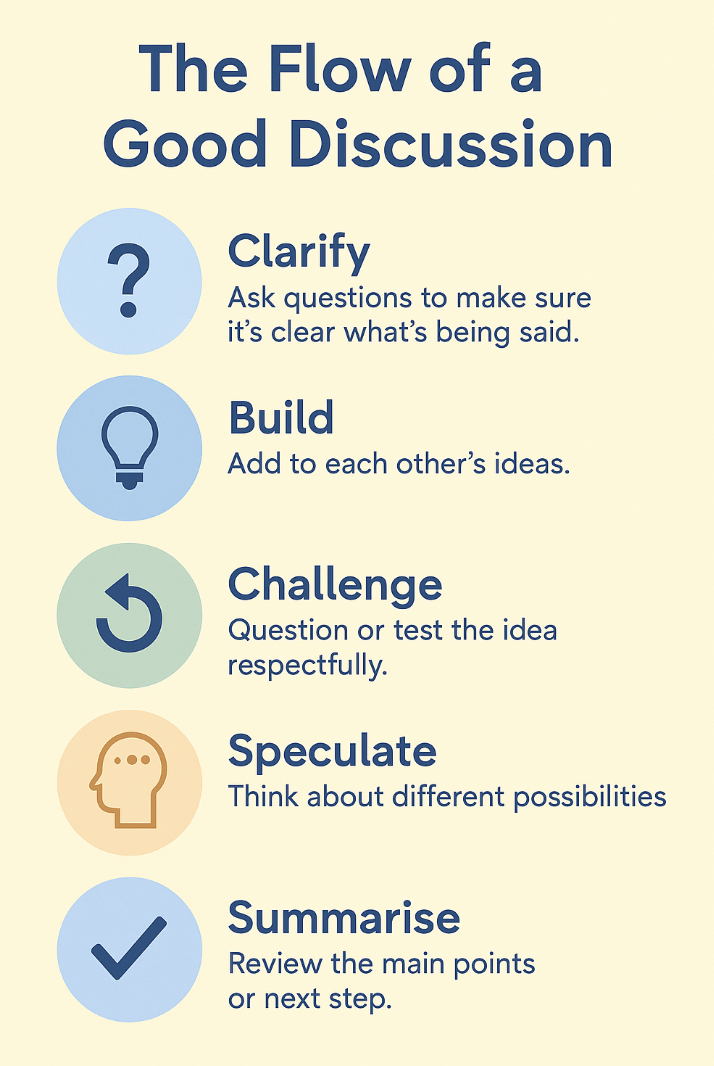
If we don’t, might it be worth investing time in doing so… Look at the exmples below, as to how you would apply the prompts above…
1. Building Understanding
Purpose: Clarify ideas so everyone knows what’s being discussed.
Talk Moves: Ask for explanation, check meaning, restate in your own words.
Examples:
- “Can you explain that again but in a simpler way?”
- “So you mean that…?”
- “Can I check if I’ve understood you — you’re saying that…?”
- “Could someone give an example of that from the text/lesson?”
2. Agreeing and Extending
Purpose: Build on someone else’s idea rather than just repeating it.
Talk Moves: Add, link, or apply.
Examples:
- “I agree with you because…”
- “Adding to your point, maybe…”
- “That links to what we said earlier about…”
- “If that’s true, then it might also mean that…”
3. Questioning and Challenging
Purpose: Explore different perspectives respectfully.
Talk Moves: Ask for evidence, test the idea, imagine the opposite.
Examples:
- “What makes you think that?”
- “Could there be another reason?”
- “How would that work if…?”
- “I see it differently because…”
- “What would someone who disagrees say?”
4. Speculating and Hypothesising
Purpose: Stretch thinking and imagination beyond the obvious.
Talk Moves: Play with possibilities, predict, imagine alternatives.
Examples:
- “What might happen if we changed…?”
- “Suppose we were in that situation — what could we do?”
- “If the opposite were true, how would that change things?”
- “How might this idea work in the future?”
5. Summarising and Concluding
Purpose: Pull ideas together so the group can agree or move forward.
Talk Moves: Paraphrase, identify common ground, evaluate.
Examples:
- “So, what we’ve all agreed is…”
- “The main point seems to be…”
- “What we still don’t know is…”
- “Has anyone changed their mind? Why?”