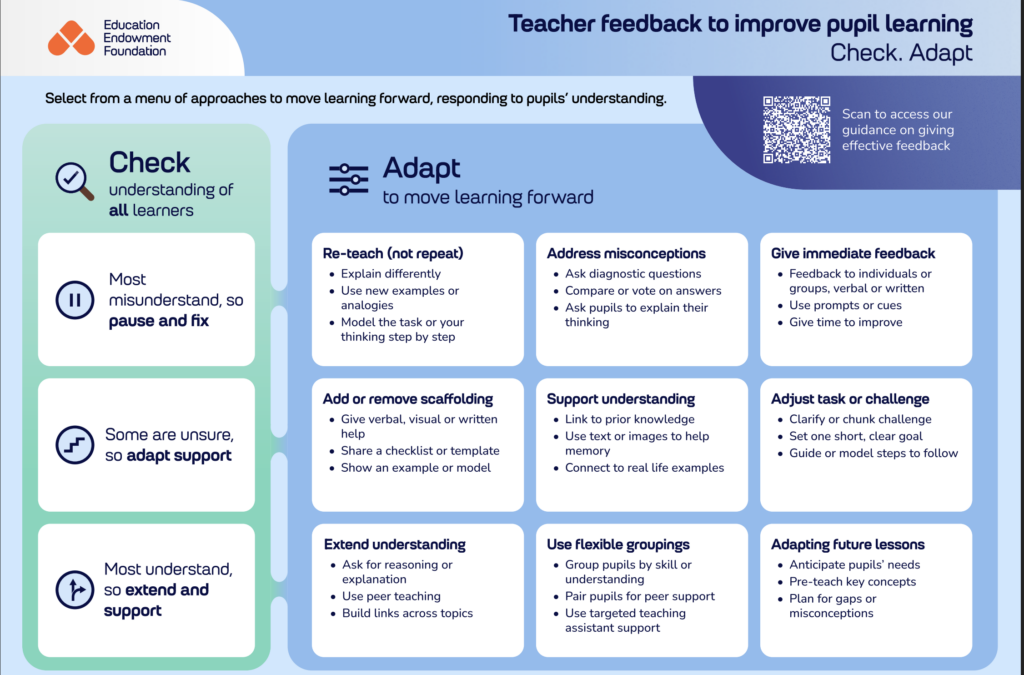
This comes from the Education Endowment Foundation’s guidance on adaptive teaching:
👉 Checking for Understanding that Leads to Action (EEF, 2025) — https://educationendowmentfoundation.org.uk/news/checking-for-understanding-that-leads-to-action-adaptive-teaching
Resources
- Mini whiteboards + pens
- Exit tickets (paper or digital)
- Hinge questions designed with common misconceptions in mind
- Visualiser or projected exemplar responses
- A simple tracking sheet to spot patterns in responses
Source and Image referene: Education Endowment Foundation, EEF ➤ https://educationendowmentfoundation.org.uk/news/checking-for-understanding-that-leads-to-action-adaptive-teaching
What to do
- Start with one clear check
Choose the specific concept you want to test. Craft a hinge question that directly exposes likely misunderstandings. - Get responses from everyone
Use whiteboards, exit tickets, or selected written answers — avoid only relying on volunteers only. - Interpret responses quickly
Look for patterns:- Is the issue conceptual, procedural, or vocab-based?
- Are many pupils making the same error?
- Who is totally secure and who is not?
- Respond in the moment
Your next move should be informed by what you’ve seen:- Re-model using a different representation
- Rephrase key steps aloud
- Structure think-pair-share
- Add a scaffold for those struggling, extension for those ready
- Re-check to confirm impact
After adapting, ask a quick follow-up check to see if the misunderstanding has been resolved.
EEF’s point is clear: a check that doesn’t change your instruction is a check without purpose.
Variations
- Confidence rating scale: pupils self-rate their confidence before explaining one point
- Error spotting: present a commonly misunderstood example and ask pupils to correct it
- Delayed hinge: revisit the same diagnostic question later in the lesson
- Silent written check: reduces peer influence and gives clearer individual responses
- Patterned exit tickets: categorise responses into “secure / partial / misconception” to guide next lesson planning
Adaptations should always be driven by evidence gathered from the class, not guesswork.